


NEW YORK
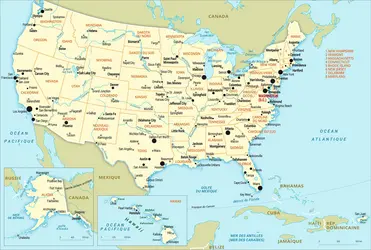
États-Unis : carte administrative
Encyclopædia Universalis France
Le nom de New York renvoie à deux réalités urbaines : la ville et l'aire métropolitaine, dénommée par le bureau du recensement « Consolidated Metropolitan Statistical Area » (CMSA). Cette catégorie statistique englobe ici une douzaine de métropoles et leurs banlieues respectives, soit vingt-cinq comtés répartis dans trois États, New York, New Jersey et Connecticut. En tant que première ville des États-Unis, New York comptait, en 2017, 8,6 millions d'habitants et, en tant que première métropole, près de 20,3 millions d'habitants. C'est la ville américaine dont la densité est la plus forte, avec 7 000 habitants au kilomètre carré. Pour le géographe Jean Gottmann, New York appartient en réalité au continuum urbain qui s'étend de Boston à Washington DC et qu'il a qualifié en 1961 de « mégalopolis ».
Pleine de contrastes tant par son architecture que par sa population, New York est l'un des meilleurs exemples de ville ayant réussi à évoluer parallèlement aux modes de production et à l'arrivée de nouvelles populations. Dès le début des années 1990, elle a été qualifiée de « ville globale », en raison du rôle incontournable de sa Bourse dans les marchés financiers, à l'heure de la mondialisation.
Même si elle a été durement touchée par des actes terroristes en septembre 2001 New York, mieux que n'importe quelle ville des États-Unis, illustre la puissance américaine au début du xxie siècle et le défi d'une société qui pendant longtemps s’est identifiée au refrain « We are the World ».
La configuration spatiale de la ville

New York
Encyclopædia Universalis France
New York s'étend sur un site composé d'îles et de chenaux offrant des conditions favorables à la défense, à la navigation et aux installations portuaires, conditions qui ont certainement dû être prises en compte par les Hollandais quand ils achetèrent les terrains aux premiers habitants, les Indiens. Manhattan, dont le nom a une origine relativement obscure, commença d'être habitée par des Européens lorsque la Compagnie hollandaise des Indes orientales y établit un comptoir, en 1624, sur la pointe sud de l'île. Mais la Nouvelle Amsterdam ne tarda pas à devenir britannique, en 1664, et prit le nom de New York. La ville s'étend sur 843,5 kilomètres carrés depuis 1898, année au cours de laquelle l'État autorisa la municipalité de Manhattan à annexer de nouveaux territoires qui constituent les quatre autres boroughs ou arrondissements (Bronx, Brooklyn, Queens et Staten Island) de New York.
Bronx
Le Bronx (au nord de Manhattan) est le seul arrondissement localisé sur le continent. Son territoire, de 109 kilomètres carrés (dont un quart est occupé par des parcs), comptait 1,4 million d’habitants en 2017. Il fut pendant longtemps essentiellement habité par des protestants, avant d'accueillir, à partir de la seconde moitié du xixe siècle, des catholiques irlandais et allemands. En 1904, une première ligne de métro fut inaugurée, ce qui permit à des milliers d'habitants de Manhattan, une population largement composée de Juifs originaires d'Europe centrale, de quitter leurs logements vétustes pour des appartements modernes dans le Bronx. La construction du Yankee Stadium (pour l’équipe de base-ball), dans les années 1920, a entraîné le développement des activités commerciales ainsi que l'installation de salles de cinéma et de théâtres. Le plus grand ensemble résidentiel des années 1920, Parkchester, construit par la Metropolitan Life Insurance Company et comprenant des commerces et des activités de loisirs, comptait 40 000 habitants. Inauguré en 1899, le zoo du Bronx constituait – et reste encore – un lieu de visite très fréquenté.
Après la Seconde Guerre mondiale, le profil du Bronx a évolué parallèlement à la construction d'appartements de luxe du côté de Riverdale, vers[...]
La suite de cet article est accessible aux abonnés
- Des contenus variés, complets et fiables
- Accessible sur tous les écrans
- Pas de publicité
Déjà abonné ? Se connecter
Écrit par
- Cynthia GHORRA-GOBIN : directrice de recherche émérite au CNRS-CREDA, université Sorbonne Nouvelle, Paris, professeur à l'institut des hautes études de l'Amérique latine, Paris
Classification
Pour citer cet article
Cynthia GHORRA-GOBIN. NEW YORK [en ligne]. In Encyclopædia Universalis. Disponible sur : (consulté le )
Médias
États-Unis : carte administrative
Encyclopædia Universalis France
New York
Encyclopædia Universalis France

Pont de Brooklyn achevé
Hulton Archive/ Getty Images
Autres références
-
AGRICULTURE URBAINE
- Écrit par Jean-Paul CHARVET, Xavier LAUREAU
- 6 273 mots
- 8 médias
...routière ou ferroviaire…). Un exemple très connu est celui des fermes Lufa (Lufa Farms), implantées dans la région métropolitaine de Montréal au Canada. À New York, des restaurants de l’île de Manhattan tels que River Park Farm ou Bell Book & Candle, qui proposent des produits provenant de cultures « urbaines... -
AMÉRIQUE (Structure et milieu) - Géographie
- Écrit par Jacqueline BEAUJEU-GARNIER, Danièle LAVALLÉE, Catherine LEFORT
- 18 105 mots
- 9 médias
 ...entre les Blancs issus du même continent, les rapports ne sont pas toujours aisés. Les origines diverses se marquent à travers les paysages américains. Il n'est pas difficile de reconnaître à New York les rues où vivent les Italiens, les Irlandais... Cette ville est non seulement une des plus peuplées...
 -
ART URBAIN
- Écrit par Stéphanie LEMOINE
- 2 727 mots
- 4 médias
...États-Unis un mouvement esthétique promis à une diffusion internationale : le writing (nom donné par les Anglo-Saxons au graffiti d'inspiration new-yorkaise et que les graffeurs préfèrent à celui, trop générique, de graffiti). Porté par l'essor du Civil Rights Movement, ce mode d'expression minoritaire... -
BARTHOLDI FRÉDÉRIC AUGUSTE (1834-1904)
- Écrit par Thérèse BUROLLET
- 1 100 mots
- 2 médias

Architecte et sculpteur français. Bartholdi perd très tôt son père et est élevé par une mère sévère qui n'approuve guère son goût pour les arts ni ses résultats médiocres au lycée Louis-le-Grand. Elle lui permet cependant d'étudier l'architecture puis la peinture dans l'atelier d'...
- Afficher les 38 références
Voir aussi
- TRANSPORTS ÉCONOMIE DES
- MIGRATIONS HISTOIRE DES
- CONNECTICUT
- INDES ORIENTALES COMPAGNIE HOLLANDAISE DES
- MANHATTAN
- HARLEM
- LONG ISLAND
- QUEENS
- BRONX
- BROOKLYN
- WORLD TRADE CENTER ATTENTATS DU (11 sept. 2001)
- NEW YORK, État
- NEW JERSEY, État
- AMÉNAGEMENT DE L'ESPACE URBAIN
- AUTOROUTES
- TRANSPORTS URBAINS
- TRANSPORTS EN COMMUN
- MÉTRO
- ÉTATS-UNIS D'AMÉRIQUE, géographie
- GROUND ZERO, New York
- GREENWICH VILLAGE
- STATEN ISLAND
- IMMIGRATION
- ÉTATS-UNIS D'AMÉRIQUE, histoire, des origines à 1865
- ÉTATS-UNIS D'AMÉRIQUE, économie
- AMÉRICAINE ARCHITECTURE
- POLITIQUE SOCIALE
- AFRO-AMÉRICAINS ou NOIRS AMÉRICAINS