


HAMPTON LIONEL (1908-2002)
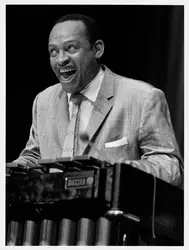
Lionel Hampton
Hulton-Deutsch/ Corbis Historical/ Getty Images
Dernier représentant de la génération qui jette les fondations du jazz, Lionel Hampton est l'une des plus irrésistibles incarnations du dynamisme en musique. Le vocaliste ne laissera pas un souvenir impérissable. Au piano, à la batterie ou à la tête d'orchestres de taille et de qualité diverses, sa pétulance et son sens du spectacle ont en revanche enthousiasmé les foules. Mais c'est au vibraphone qu'il doit sa place dans l'histoire : il révélera en effet toutes les possibilités d'un instrument dont le rôle était jusque-là resté anecdotique. L'interprète y montre une invention, une fougue et une virtuosité inimaginables, ouvrant la voie à des personnalités qui, comme Milt Jackson ou Gary Burton, conduiront l'instrument sur d'autres chemins esthétiques.
Le vibraphone comme soliste
Lionel Leo Hampton serait né à Louisville (Kentucky), probablement le 20 avril 1908, et non pas à Birmingham (Alabama) le 12 avril 1909, lieu et date qui sont mentionnés dans beaucoup de biographies, mais qui sont invalidés par un certificat de naissance découvert par le producteur et historien du jazz Phil Schaap dans les archives de Louisville.
Les Hite l'engage en 1930 comme batteur dans une formation qui accompagne Louis Armstrong. Le trompettiste est le témoin admiratif des premiers essais de Lionel Hampton sur un vibraphone trouvé dans un coin de studio. Ce premier auditeur enthousiaste met tout son poids dans la balance pour lui permettre d'enregistrer, le 16 octobre 1930, son premier solo sur plaques métalliques, Memories of You. Benny Goodman, déjà illustre grâce à un trio qui rassemble autour de lui le pianiste Teddy Wilson et le batteur Gene Krupa, le choisit en 1936 pour constituer un quartette appelé à la même célébrité. Derrière la clarinette au style assez convenu du leader, Lionel Hampton s'impose, dès les premiers enregistrements du groupe, comme un animateur de premier ordre.
Les meilleurs solistes des big bands veulent jouer avec Hampton. Bien qu'issus d'horizons musicaux parfois opposés, ils réussissent grâce à lui à bâtir un univers musical cohérent et séduisant. En témoigne cette séance du 11 septembre 1939 qui rassemble Dizzy Gillespie, Benny Carter, Coleman Hawkins, Ben Webster, Chu Berry, Clide Hart, Milt Hinton, Charlie Christian et Cozy Cole pour un enregistrement resté dans les annales. Le jeu du vibraphoniste est, il est vrai, hallucinant. Utilisant des mailloches longues, grosses et assez dures, Hampton sidère par une virtuosité rythmique inouïe. Ce maître de la paraphrase propose des développements toujours inattendus d'où fusent, stimulés par l'exubérance des idées, contrastes inopinés et cascades d'arpèges. Sa sonorité, riche et cristalline, sait se faire percussion éclatante sur les tempos rapides mais aussi effleurement sensuel dans les mouvements lents. Le 10 mai 1940, il est en studio avec le trio de Nat King Cole ; les micros saisissent alors, sur Jack the Bellboy, l'un de ces solos de batterie qui comptent dans l'histoire de l'instrument : spécialiste incontesté des tambours et des cymbales, Hampton libère un swing insurpassable. Une autre plage de la même session, Central Avenue Breakdown, le met en vedette dans une improvisation explosive au piano : attaquant le clavier dans le registre aigu avec ses deux index comme avec deux mailloches, il submerge l'auditeur sous un déluge de notes frappées avec une énergie dévastatrice.
La suite de cet article est accessible aux abonnés
- Des contenus variés, complets et fiables
- Accessible sur tous les écrans
- Pas de publicité
Déjà abonné ? Se connecter
Écrit par
- Pierre BRETON : musicographe
Classification
Pour citer cet article
Pierre BRETON. HAMPTON LIONEL (1908-2002) [en ligne]. In Encyclopædia Universalis. Disponible sur : (consulté le )
Média
Lionel Hampton
Hulton-Deutsch/ Corbis Historical/ Getty Images
Autres références
-
BUCKNER MILTON (1915-1977)
- Écrit par Denis Constant MARTIN
- 634 mots
Sa verve s'exprimait en musique comme dans tout le reste de sa vie. Pianiste et organiste, Milton « Milt » Buckner voulait être à la fois un homme de spectacle et un musicien ; il souhaitait que sa musique plaise, par sa force rythmique, qu'elle détende et amuse ; mais il ne fit jamais de concessions...
-
JAZZ
- Écrit par Philippe CARLES, Jean-Louis CHAUTEMPS, Universalis, Michel-Claude JALARD, Eugène LLEDO
- 10 992 mots
- 25 médias
...ainsi qu'aux bassistes Jimmy Blanton, de chez Ellington, et Walter Page, de chez Basie. Elle doit tout autant à cet ancien batteur devenu vibraphoniste, Lionel Hampton, tempérament inventif et bouillant qui, après avoir animé, à la fin des années 1930, de petites formations à l'admirable équilibre (...
Voir aussi